Cloverleaf Quasar
Galaxy in Boötes · Quasar
Also known as H1413+117, Cloverleaf quasar
About Cloverleaf Quasar
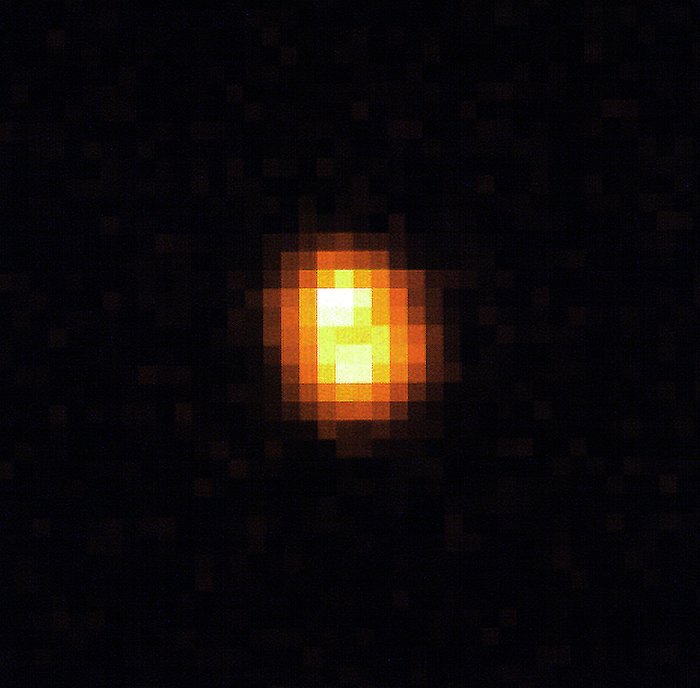
The Cloverleaf Quasar is a very distant quasar, the brilliant core of a young galaxy, whose light has been split into four images. A galaxy lying between it and Earth bends its light like a lens, an effect called gravitational lensing, and the four spots form a cloverleaf. Hazard, Morton, Terlevich and McMahon, a team of astronomers, found it in 1984.
- Distance
- 19.4 billion light-years
- Redshift
- z = 2.48732
- Light travel time
- 11.2 billion years
- Constellation
- Boötes
- Apparent magnitude
- 17.23
Looking back in time
The light from Cloverleaf Quasar that reaches Earth tonight has been travelling for about 11 billion years. It set off before the Sun and the Earth had formed, about 4.6 billion years ago. That is less than its distance today, 19 billion light-years: the universe has been expanding while the light was on its way, so Cloverleaf Quasar is now farther away than the light has travelled. It shows Cloverleaf Quasar as it was when the universe was 2.6 billion years old, a fifth of its present age.
Finding it in the sky
Cloverleaf Quasar lies in the constellation Boötes. Its address on the map of the sky is right ascension 14h 16m, declination 11° 30′ north. Declination works like latitude on Earth, so Cloverleaf Quasar passes straight overhead for anyone at latitude 11° N. It can be seen from anywhere north of 79° S, which includes almost everywhere people live.
| Seen from | Cloverleaf Quasar |
|---|---|
| Oslo59.9° N | Climbs to 42° above the southern horizon |
| London51.5° N | Climbs to 50° above the southern horizon |
| New York40.7° N | Climbs to 61° above the southern horizon |
| Singapore1.3° N | Climbs to 80° above the northern horizon |
| Sydney33.9° S | Climbs to 45° above the northern horizon |
Cloverleaf Quasar is highest in the sky at about 10 in the evening, local time, from April to June: spring in the northern hemisphere, autumn in the southern. At magnitude 17.2 it is beyond all but the largest telescopes, and is studied with long-exposure photographs. The light of Cloverleaf Quasar is spread over an area of sky, so it looks fainter than a star of magnitude 17.2 would.
Heights are for the moment Cloverleaf Quasar crosses the north–south line, its highest point each day, ignoring the slight lift that the air gives to everything near the horizon.
Getting there from Earth
Cloverleaf Quasar is about 19 billion light-years from Earth.
| Going | The trip would take |
|---|---|
| On footwalking at 5 km/h, without stopping | about 4,200,000 trillion years |
| By cardriving at 100 km/h, without stopping | about 210,000 trillion years |
| By airlinercruising at 900 km/h | about 23,000 trillion years |
| At the fastest any people have travelledApollo 10’s 39,900 km/h on its way home from the Moon in 1969 | about 530 trillion years |
| At Voyager 1’s speedabout 61,000 km/h, the speed it is leaving the Solar System at | about 340 trillion years |
| At the fastest any spacecraft has flownParker Solar Probe’s 692,000 km/h as it swings past the Sun | about 30 trillion years |
| At the speed of light300,000 km every second, as fast as anything can go | about 19 billion years |
Stellar Voyager flies you there in 15 seconds to 10 minutes, as you choose: a 10-minute trip means averaging 1,000 trillion times the speed of light, and a 15-second dash 41,000 trillion times the speed of light.
More quasars
- 3C 273 Galaxy in Virgo
- Einstein Cross Galaxy in Pegasus
- Twin Quasar Galaxy in Ursa Major
Nearest places in space
- TON 618 10 billion light-years from here
- Cosmic Horseshoe 15 billion light-years from here
- Abell 1689 17 billion light-years from here
- 3C 273 18 billion light-years from here
- Abell 2218 18 billion light-years from here
- IC 1101 18 billion light-years from here