Caliban
Moon of Uranus
Also known as S/1997 U1, Uranus XVI
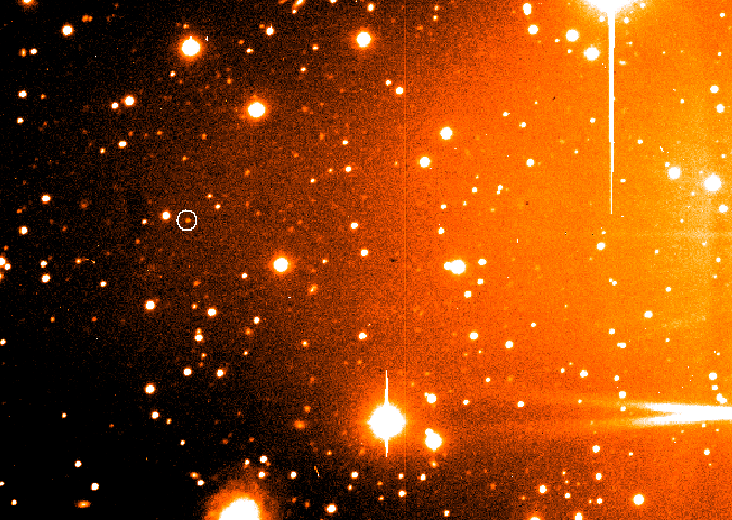
About Caliban
Circling Uranus backwards far beyond its main moons, Caliban is the planet's second-biggest irregular moon, about 36 km in radius. It was found on 6 September 1997, together with Sycorax, by Brett Gladman, Philip Nicholson, Joseph Burns and John Kavelaars with the 200-inch Hale Telescope. Its name belongs to the monstrous servant in Shakespeare's The Tempest, and one orbit takes 580 days.
- Orbits
- Uranus
- Radius
- about 36 km
- Distance from Uranus
- 7,167,000 km on average (eccentricity 0.20)
- Orbital period
- 580.0 days (retrograde: it orbits backwards)
- Discovered
- 1997 by B.J. Gladman, P.D. Nicholson, J.A. Burns, J.J. Kavelaars
Compared with Earth
Caliban is about 72 km across, 2% the width of our Moon and about 1.7 times a marathon. It is the 48th largest of the 175 moons in the catalogue with a known size. It goes round Uranus once every 580 days, 7,170,000 km from its centre on average, 19 times the distance from Earth to the Moon. Of the 27 moons of Uranus in the catalogue, it is the 20th closest.
Light from Caliban takes 2 hours 33 minutes to reach Earth today, so that is how out of date your view of it is. Sunlight takes 2 hours 41 minutes to get there (8 minutes 13 seconds to Earth): Caliban is 19.4 AU from the Sun, 20 times as far from the Sun as Earth is today. Sunlight there is only about 1/390 as bright as on Earth. (Worked out for Wednesday, 18 November 2026 (UTC).)
Finding it in the sky
Seen from Earth it never strays far from Uranus: at most about 9.1 arcminutes from it when Uranus is closest to us, a tiny fraction of the width of the full Moon.
Getting there from Earth
The distance to Caliban changes every day. These figures are for Wednesday, 18 November 2026 (UTC), when this page was made; with JavaScript on, they are worked out for today.
On Wednesday, 18 November 2026, Caliban is about 18 AU (2.8 billion km) from Earth. A radio message, travelling at the speed of light, takes 2 hours 33 minutes to get there.
| Going | The trip would take |
|---|---|
| On footwalking at 5 km/h, without stopping | about 63,000 years |
| By cardriving at 100 km/h, without stopping | about 3,100 years |
| By airlinercruising at 900 km/h | about 350 years |
| At the fastest any people have travelledApollo 10’s 39,900 km/h on its way home from the Moon in 1969 | about 7.9 years |
| At Voyager 1’s speedabout 61,000 km/h, the speed it is leaving the Solar System at | about 5.2 years |
| At the fastest any spacecraft has flownParker Solar Probe’s 692,000 km/h as it swings past the Sun | about 5.5 months |
| At the speed of light300,000 km every second, as fast as anything can go | about 2.6 hours |
Stellar Voyager flies you there in 15 seconds to 10 minutes, as you choose: a 10-minute trip means averaging 15 times the speed of light, and a 15-second dash 610 times the speed of light.