Ocean worlds and the search for life
Hidden oceans, ancient rivers and faraway planets: the places where we look for life beyond Earth.
Start this tour in Star Explorer
8 stops. Fly them in order, or in any order you like: in the app, every stop you have already visited counts, whenever you went.
-
1 Mars
Planet
Mars is cold and dry today, but long ago rivers and lakes ran across it. Rovers are searching its rocks for signs that tiny living things were once there.

Photo: Kevin Gill from Los Angeles, CA, United States · CC BY 2.0 -
2 Europa
Moon
Under Europa’s icy crust lies a deep, salty ocean that may hold more water than all of Earth’s oceans together. It is one of the best places to look for life beyond Earth.

Photo: NASA/JPL-Caltech/SwRI/MSSS/Kevin M. Gill · CC BY 2.0 -
3 Ganymede
Moon
The biggest moon in the Solar System, larger even than the planet Mercury. A salty ocean is thought to lie buried deep beneath its ice.

Photo: NASA/JPL-Caltech/SwRI/MSSS/ Kevin M. Gill · CC BY 2.0 -
4 Enceladus
Moon
Jets of water spray out of cracks near the south pole of Enceladus, fed by an ocean under the ice. The Cassini spacecraft flew right through them and found salt and carbon-based chemicals.

Photo: National Aeronautics and Space Administration (NASA) / Jet Propulsion Laboratory (JPL) · Public domain -
5 Titan
Moon
Titan is the only moon with a thick atmosphere, and the only place besides Earth known to have lakes and seas, though these are filled with liquid methane and ethane, not water. Deeper down there is probably an ocean of water.
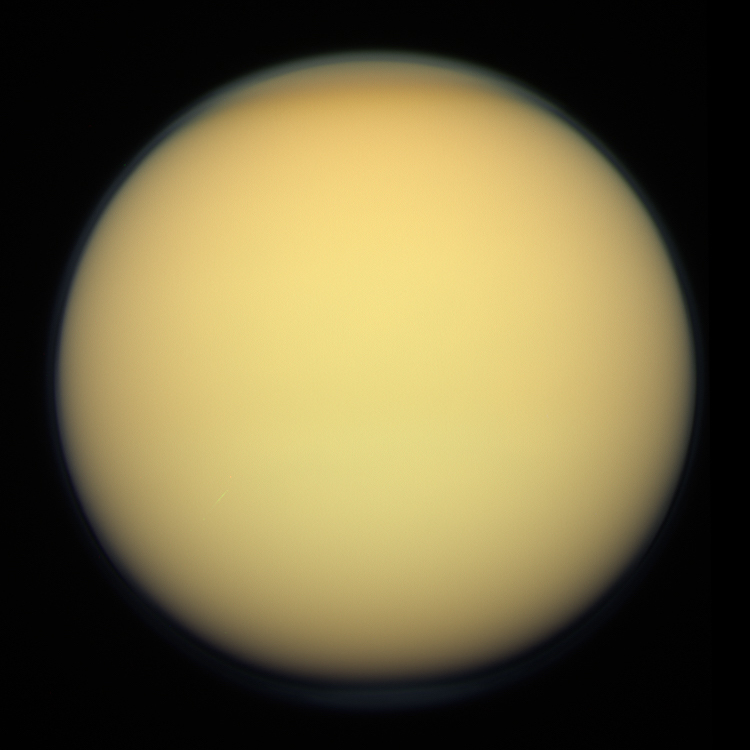
Photo: NASA/JPL-Caltech/SSI/Kevin M. Gill · CC BY 2.0 -
6 Proxima Centauri
Red dwarf
Now leave the Solar System. The nearest star to the Sun, about 4.23 light-years away, has a planet in its “habitable zone”, where it is neither too hot nor too cold for liquid water.

Photo: ESA/Hubble & NASA · CC BY 4.0 -
7 TRAPPIST-1
Red dwarf
This small, cool star, about 40.5 light-years away, has 7 planets about the size of Earth, and a few of them are at the right distance for liquid water.
-
8 K2-18
Red dwarf
This red dwarf, about 124 light-years away, has a planet bigger than Earth that may be covered by a deep ocean. The James Webb Space Telescope found methane and carbon dioxide in its atmosphere.


Start this tour in Star Explorer
More guided tours
- First voyage 6 stops · Short trips from the Moon out to another galaxy, each one much farther than the last.
- A grand tour of the planets 7 stops · Every planet in order, outwards from the Sun, from scorching Mercury to icy Neptune.
- The Apollo landings 6 stops · Every place where astronauts landed and walked on the Moon, in the order they got there.
- The Sun’s nearest neighbours 9 stops · Meet the stars closest to our own, nearest first.
- The life of a star 8 stops · Follow a star from the cloud where it is born to what it leaves behind when it dies.
- In Voyager’s wake 9 stops · Follow the two Voyager spacecraft past the giant planets and out to where they are today.
- Showpieces of the deep sky 7 stops · Some of the finest nebulae, star clusters and galaxies in the sky, nearest first.
- To the edge of the universe 8 stops · From the Milky Way’s neighbours out to the most distant galaxy in the catalogue.