In Voyager’s wake
Follow the two Voyager spacecraft past the giant planets and out to where they are today.
Start this tour in Star Explorer
9 stops. Fly them in order, or in any order you like: in the app, every stop you have already visited counts, whenever you went. Planets, moons and spacecraft move, so their distances change from day to day; the ones marked here were worked out for 17 November 2026.
-
1 Jupiter
Planet
Both Voyagers flew past Jupiter in 1979. Their pictures showed its giant storms up close, and Voyager 1 found a thin ring around it.

Photo: NASA/STSCI (S.T.A.R.S) · Public domain -
2 Io
Moon
Voyager 1 spotted volcanoes erupting on Io, the first active volcanoes ever seen beyond Earth.

Photo: NASA · Public domain -
3 Saturn
Planet
Voyager 1 reached Saturn in 1980 and Voyager 2 in 1981. They showed that its broad rings are made of many narrow ringlets.

Photo: NASA / JPL-Caltech / SSI / color composite by Gordan Ugarkovic · Public domain -
4 Titan
Moon
Voyager 1 swung close past Titan to study its thick orange haze. That swing bent its path up and away from the planets, so Titan was the last world it visited.
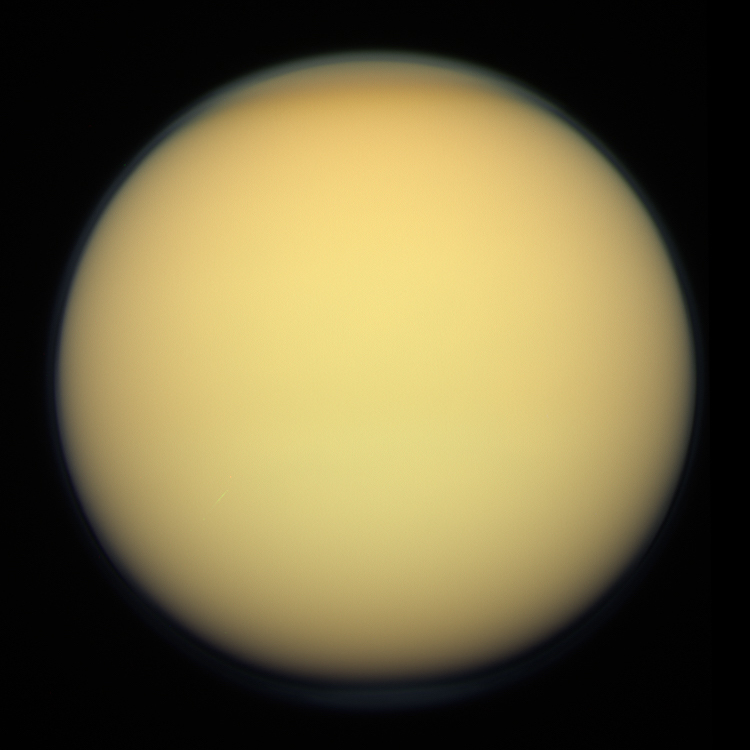
Photo: NASA/JPL-Caltech/SSI/Kevin M. Gill · CC BY 2.0 -
5 Uranus
Planet
Only Voyager 2 carried on. In 1986 it became the first spacecraft to visit Uranus, and it is still the only one.

Photo: Ardenau4 · CC0 -
6 Neptune
Planet
Voyager 2 reached Neptune in 1989 and found a huge dark storm and the fastest winds in the Solar System.

Photo: NASA / Voyager 2 / PDS / OPUS / Ardenau4 · CC0 -
7 Triton
Moon
Neptune’s biggest moon was Voyager 2’s last close-up. It saw dark plumes rising from Triton’s frozen surface, one of the coldest places ever measured.

Photo: Michael T. Bland, U.S. Geological Survey (USGS) · CC BY 4.0 -
8 Voyager 2
Spacecraft
Here is Voyager 2 today, about 145 AU from Earth. In 2018 it followed its twin out of the bubble of the Sun’s wind and into interstellar space.
Worked out for 17 November 2026.

Photo: National Aeronautics and Space Administration (NASA) · Public domain -
9 Voyager 1
Spacecraft
The farthest spacecraft from Earth: Voyager 1 is about 173 AU away. It was the first to reach interstellar space, in 2012, and its radio signals take about 24 hours to reach us.
Worked out for 17 November 2026.
Photo: National Aeronautics and Space Administration (NASA) · Public domain


Start this tour in Star Explorer
More guided tours
- First voyage 6 stops · Short trips from the Moon out to another galaxy, each one much farther than the last.
- A grand tour of the planets 7 stops · Every planet in order, outwards from the Sun, from scorching Mercury to icy Neptune.
- The Apollo landings 6 stops · Every place where astronauts landed and walked on the Moon, in the order they got there.
- The Sun’s nearest neighbours 9 stops · Meet the stars closest to our own, nearest first.
- The life of a star 8 stops · Follow a star from the cloud where it is born to what it leaves behind when it dies.
- Ocean worlds and the search for life 8 stops · Hidden oceans, ancient rivers and faraway planets: the places where we look for life beyond Earth.
- Showpieces of the deep sky 7 stops · Some of the finest nebulae, star clusters and galaxies in the sky, nearest first.
- To the edge of the universe 8 stops · From the Milky Way’s neighbours out to the most distant galaxy in the catalogue.